I went upstairs to sit with ‘Uncle’ Ron. It was a year ago. We were waiting for the ambulance to transport him to the hospice. I said “it won’t be long now Ron” and went on to tell him a little about the hospice near Porthpean in St. Austell.
He then asked me out of the blue “will I see the Sea?”.
“The hospice is close to the sea Ron, if you listen carefully, you’ll probably hear it”. I replied. Ron nodded and smiled.
Ron passed away only a few hours later, just after he arrived. He had fought cancer with dignity and courage.
I believe he heard the sea.
It was a privilege to know him and to sit with him in his final moments. It was a privilege to laugh at his antics and stories over the years and to have him in our family. I still love that moment when he showed me his new 8ft surfboard around his 70th birthday.
I wondered about his question and the timing of it. “Will I see the sea?”.
We are drawn to nature in an indescribable way, it seeps into our spirit. I’ve often thought that the soul is watered by the natural places, as well as people we love. And sometimes these two things come rightfully, and restfully, together.
For Ron it was to ‘see the sea’ with Gel (Geraldine) his wife and life-long friend. They honeymooned in Clovelly in the early 1970’s. We invited Gel to join us. We knew how important the memories of Clovelly were to Gel and she was excited to be part of the trip, lunching and reminiscing, whilst I walked the 13 miles to Clovelly.
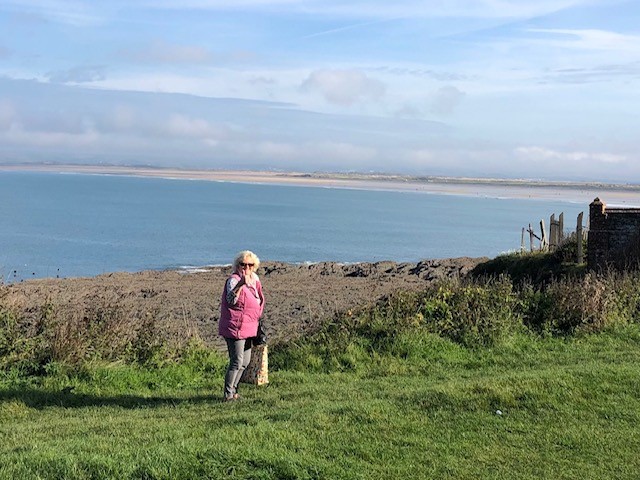
The route out was really straight forward, there was a woody mid-autumn smell in the air. I noticed how the meandering path was rising upwards. The geology was slightly changing from sandy dunes to sloping cliffs.
I was already thinking about my sausage roll at the bottom of my rucksack. I’d popped into a village bakery the day before to buy a sausage roll, the shop assistant said he had a deal going “one for £1” he then did a lengthy pause “or two for £1”.
I bought two.
I ate one outside the shop and kept the other one for my walk. I consumed it only 10 minutes in from leaving the van. I guess in the same way I used to eat my packed lunch as an 8 year old on the way to school.
No self discipline.
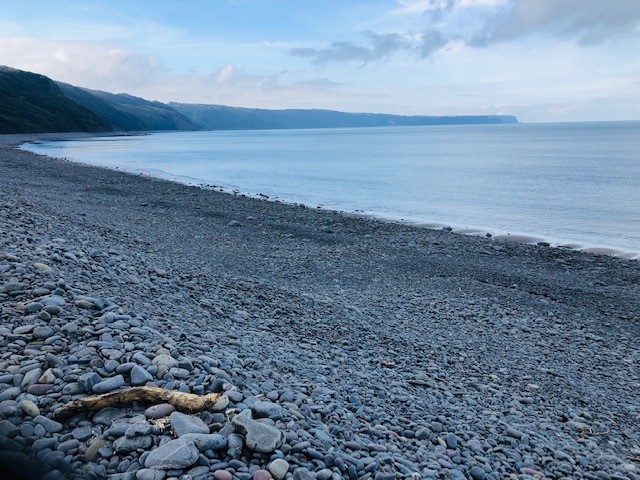
The muddy-ish route was split by rolling dark green patchwork fields with a calm shimmering cooling sea. The climbs had started to become more intense and within a few miles there was no one around. As I descended from one steep climb I discovered Peppercombe beach. One of those untouched places blanketed in drift-wood sculptures shaped by the ocean. I took some minutes there looking towards Clovelly and thinking about the shape changing journeys taken by the drift wood.
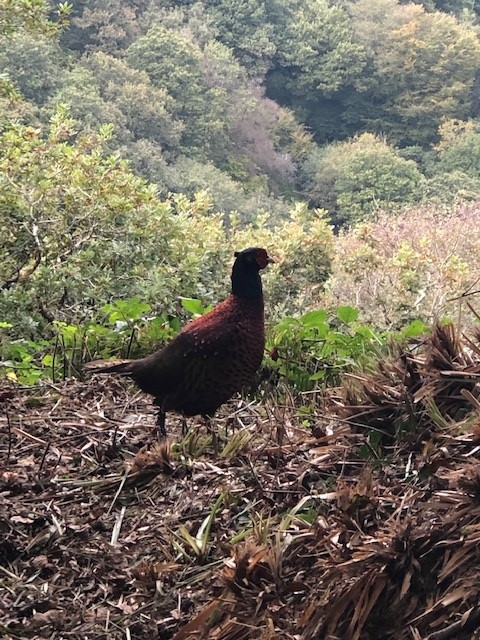
As I climbed out I heard squawks and saw 2 pheasants gladiatorially facing off to each other. I thought it must be pheasant season.
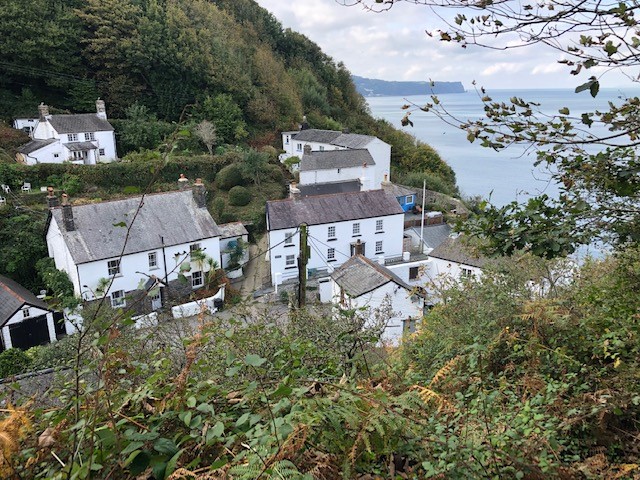
Heading through Worthygate Woods with its Oak and Beech trees shedding their leaves I stumbled upon Buck’s Mill, a unique village of 8 or 9 old properties built into the cliff with a towering waterfall running through.
Apparently Bucks Mill is in the Doomsday book with a 1086 listing. I noticed a tiny old cabin tucked away next to the waterfall, it turned out to be the creative haunt of 1920’s artists and poets Mary Stella Edwards and Judith Ackland.
I heard laughter and looked down, 50ft beneath me there were two ladies heading across the pebbles into the cold autumn sea, in their not-so-autumn swim wear. Their joy reverberated around the cliffs as they took a first full immersive dip, then a second, then a third, before an exaggerated breast stroke whilst ‘laugh-screaming’ out the cold. A picture of life, absolutely miles from anywhere. I felt happiness from their happiness.
I continued onwards into Hobby woods. I was a little lower in the valley with game-birds constantly popping out of the undergrowth like confused ducks. Pheasants are beautiful but not very high in the IQ of bird leagues. They looked a bit like the friends my Nan used to invite to Sunday tea in 1981.
Navigating my way around a corner I started to hear “thwacking” sounds like someone was slapping a hard surface with a magazine.
Then ‘it’ happened, an eruption of sound.
Above me hundreds of game-birds started cumbersomely launching into the air over the valley towards the sea with loud shrieking sounds. The “thwacks” were from ‘Pheasant Flushers’ (try to say that after a few beers), scaring the birds into flight.
Then above me came a barrage of gunfire like I’ve never heard before “BOOM! BOOM! BOOM! BOOM!”. Had I stumbled on some war-epic between man and bird?
The guns kept firing relentlessly, it seemed pheasants were being flushed out by the ‘thwacks’ and lolloping into the air above the valley to be met by a relentless 12 bore-broadside.
Feeling something brush pass my legs at light-speed, I looked down and out of the undergrowth came 2 retriever dogs, like those remote-control 4×4’s zipping around, limp pheasants dangling from their mouths.
The intensity continued. “BOOM”, “BOOM”, “SQUAWK”. Let’s face it pheasants are also not really blessed with great flying skills. I would describe them as more ‘air-balloon’ than ‘spitfire’. It was a scary place as feathers, flailing birds, and chaotic dogs were coming from all angles.
It really was an unfair fight and I imagined myself writing a book in the future called ‘A Pheasants Revenge’. I even punched the air in victory when one of the dozy-flyers made it out of the valley into a tree on the other side.
I kept moving despite the unnerving gunfire all around me and ascended from the track to be met by a chap who looked surprised, and like he had just walked out of Country Life magazine. I shall call him Lord Barrington of Bideford.
“GOOD HEAVENS! Where did you come from young man?” said Lord Barrington.
“The path down there!” I replied with a thumb gesture. Quite liking the fact he called me ‘young man’.
Noticing my welsh accent he asked, “where do you hail from?”
“I’m from Aberdare near Merthyr Tydfil!”.
For some reason the answer made perfect sense to him. Like if anyone was going to emerge from arma-pheasant-geddon it would be someone from the welsh valleys.
Rounding the corner I passed 10 new-ish Range Rovers parked on a track above and by the look of it most of the cast of Downton Abbey and Bridgerton in Barbour-clad coats sorting our their rifles.
Some 20 minutes later on the other side of the valley I clocked a few disheveled PTSD pheasants.
‘The survivors’ I figured.
As one of them ran into the bush leaving a flurry of feathers. I picked one up and clipped it to my ruck sack. I then announced to all the creatures of the woods that “I SHALL HEREBY CARRY THIS FEATHER AROUND THE WHOLE OF THE SOUTH WEST IN MEMORY OF THE FATED FLYING DUMPLINGS OF HOBBY WOODS, CLOVELLY. AMEN”.
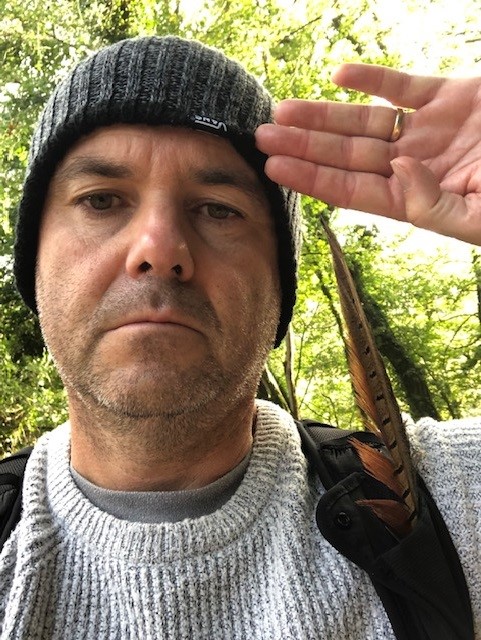
About 10 miles in and the track dropped towards Clovelly, I could hear the rolling ocean kissing the rocks below, I caught glimpses of the sea through the woody copses. I thought again of Ron. He’d have loved the story of the pheasants over one of his home made curries and a beer.
Wandering through a gate I arrived at the top of Clovelly village. Niky had texted me to amble down the cobbled hill where they would be at the beautiful Cottage Tea Rooms. Clovelly is known around the world. Owned by the Hamlyn Family since the 1700’s, the village is referenced in many works by authors Charles Dickens, Charles Kingsley and Rudyard Kipling and famously painted by Turner. In more recent times Air B&B cite Clovelly as their 3rd most trending destination in UK.
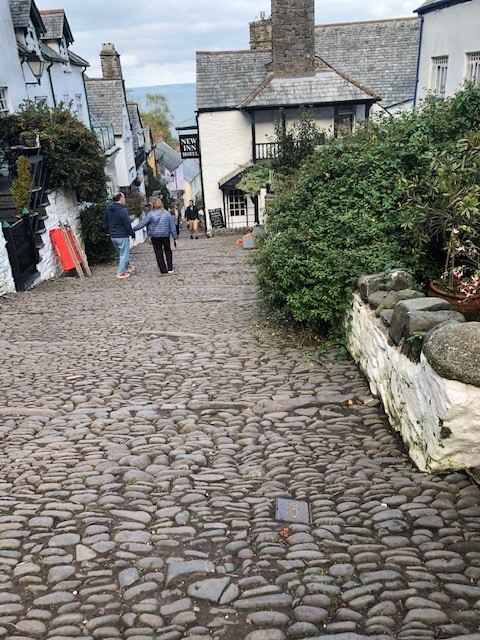
It was great to see Gel and Niky, doing lots of reminiscing about visits with Ron, and the cream tea with a sea view was fantastic. We pulled ourselves back up the bumpy hill, edging past the cottages noticing the shopping sledges outside, as no vehicles are allowed in the village. At the top I saw signs for Clovelly Brewery and thought I’d treat myself to a few bottled Clovelly Ales and send a toast to Ron.
I think I will always be a ‘sea seeker’, especially when the ‘thwacks’ of life arrive. I could hear it when we walked to back to the van. I think I will always hear the sea even if I can’t see it. Peace comes with the the presence of the ocean, it speaks deeply to us of togetherness, of rest, and of release
And for Ron perhaps the peaceful sea whispered to him, ‘time to rest, time to release’.
In memory of Ron Mansfield.
 Winging it well!
❤️ Ron would have loved this! 🙂 x